

Attachment Theory 101 - What it is and What it Can Tell You
May 23, 2026Talysha Reeve
Today, we're covering the foundations of Attachment Theory - What it is, where it came from, and why it matters to us.
The purpose of these blogs is to help people understand themselves, their body, and their relationships. I will always do my best to explain as much of the complexities in simple, easy-to-understand ways.
If you ever have any questions about this content or would like to find out about working with me, please get in touch
What Attachment Theory Can Tell Us
A simple way to summarise attachment theory is this:
Attachment theory describes how human beings seek safety through close relationships, especially when distressed.
It explains how early experiences with caregivers shape our expectations of connection, comfort, emotional availability, and repair.
It also helps explain why adult relationships can activate such strong emotional responses, because romantic partners become attachment figures, not just people we love.
When attachment needs are met consistently enough, relationships can become a source of safety, grounding, and growth.
When attachment needs are unmet, unpredictable, or associated with fear, relationships can become places of anxiety, avoidance, confusion, protest, shutdown, or emotional dysregulation.
Importantly, attachment theory is not about blaming parents, diagnosing partners, or putting people into rigid boxes.
It is about understanding the protective patterns people develop around closeness, safety, threat, and emotional need.
At its most practical, attachment theory helps us ask:
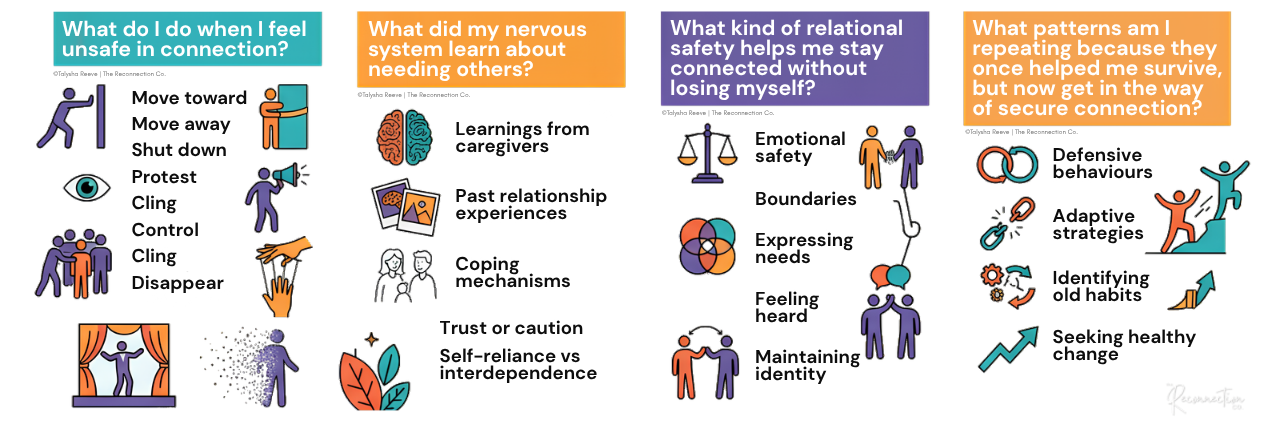
What do I do when I feel unsafe in connection?
Do I move toward, move away, shut down, protest, cling, control, perform, or disappear?
What did my nervous system learn about needing others?
People can meet my needs vs I can't rely on others to meet my needs
What kind of relational safety helps me stay connected without losing myself?
What do I need to feel seen, safe, and heard in my relationship?
What patterns am I repeating because they once helped me survive, but now get in the way of secure connection?
These are often the default relational 'roles' and/or our 'activated' attachment patterns.
What Attachment Theory Can't Tell Us
This is where it's important to be precise, because attachment theory gets misused, and that matters.
Knowing your attachment patterns isn't about labelling yourself or your partner.
Insecure attachment styles are not
- A diagnosis
- A mental health condition
- A psychopathology
Research describes insecure attachment as a risk factor, a context, a pattern shaped by experience not a fixed character flaw or a clinical disorder (2). Most people sit somewhere on a spectrum, with elements of more than one pattern showing up depending on the relationship and the circumstances.
Attachment theory also isn't a complete explanation for behaviour or relational difficulties, and it should not be used to pathologise partners or explain away harmful behaviour.
Anxious attachment style doesn't justify being treated poorly.
Avoidant attachment style doesn't explain or excuse consistent emotional unavailability or cruelty.
Attachment theory is not a framework for diagnosing narcissistic personality disorder, explaining abuse, or deciding whether someone is fundamentally capable of love.
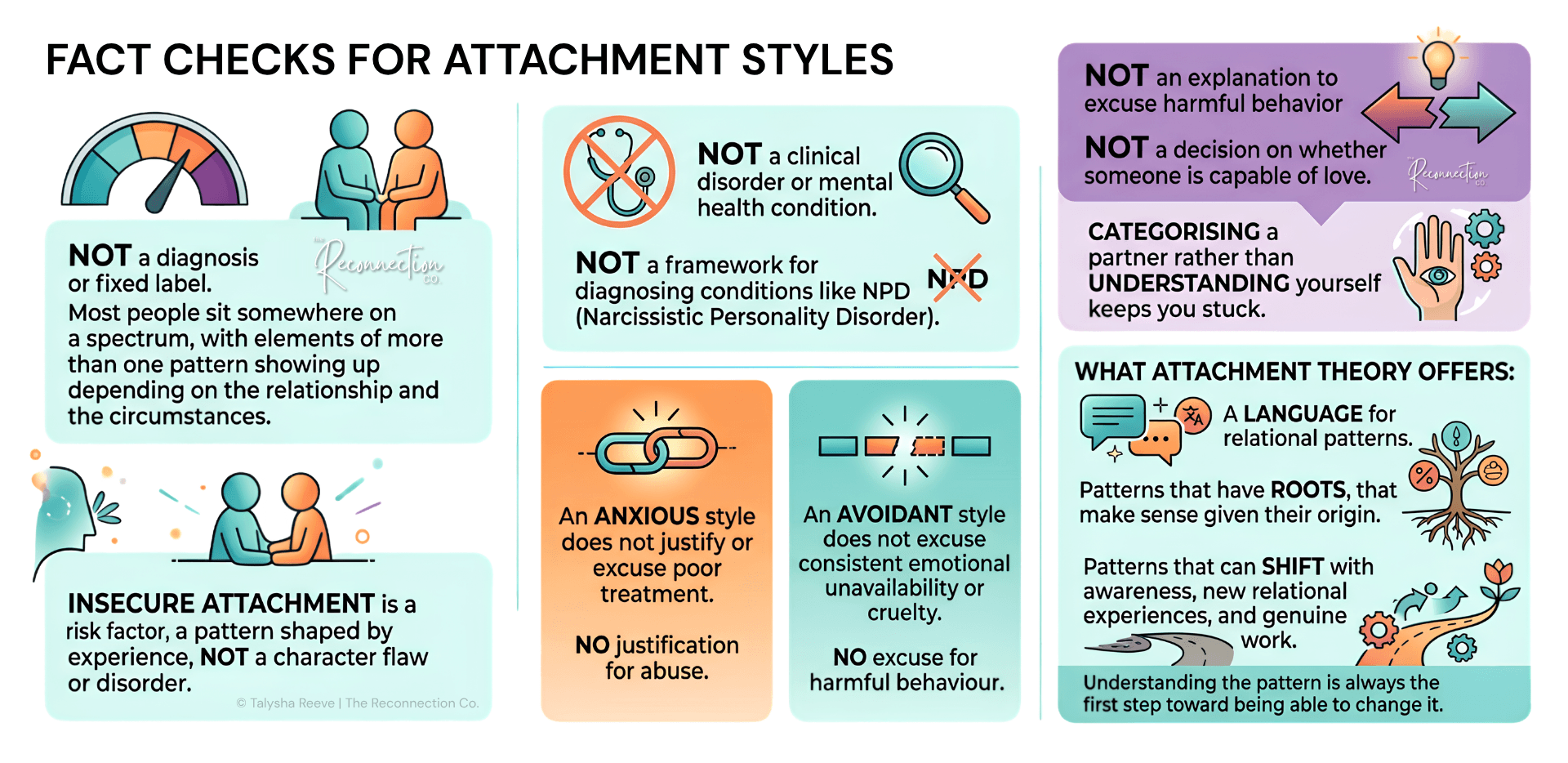
Attachment theory offers is a language for relational patterns.
Patterns that have roots, patterns that make sense given where they came from, and patterns that can shift with awareness, new relational experiences, and genuine work (2).
Understanding the pattern is always the first step toward being able to change it.
Where Did Attachment Theory Come From?
Attachment theory is not a new concept, it has been in existence and evolving for over 60 years.
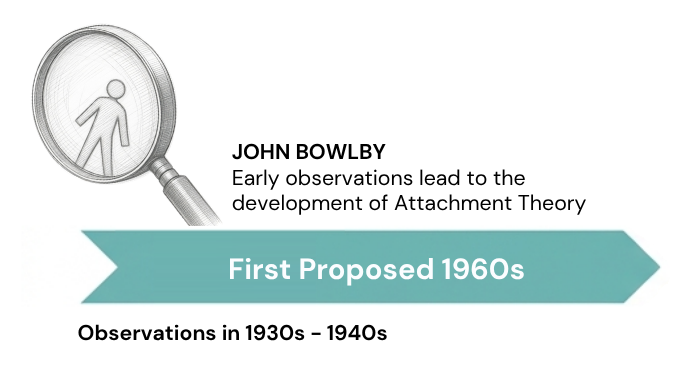
Attachment theory was first proposed by British psychiatrist John Bowlby in the 1960s. Throughout his earlier career in the 1930s and 1940, he was becoming increasingly aware of the link between negative experiences in childhood and the increased risk of negative consequences later in life.
Essentially, Bowlby was beginning to identify that: what happened to children in their early relationships with caregivers seemed to have profound and lasting effects on their psychological, emotional, and relational development (14).
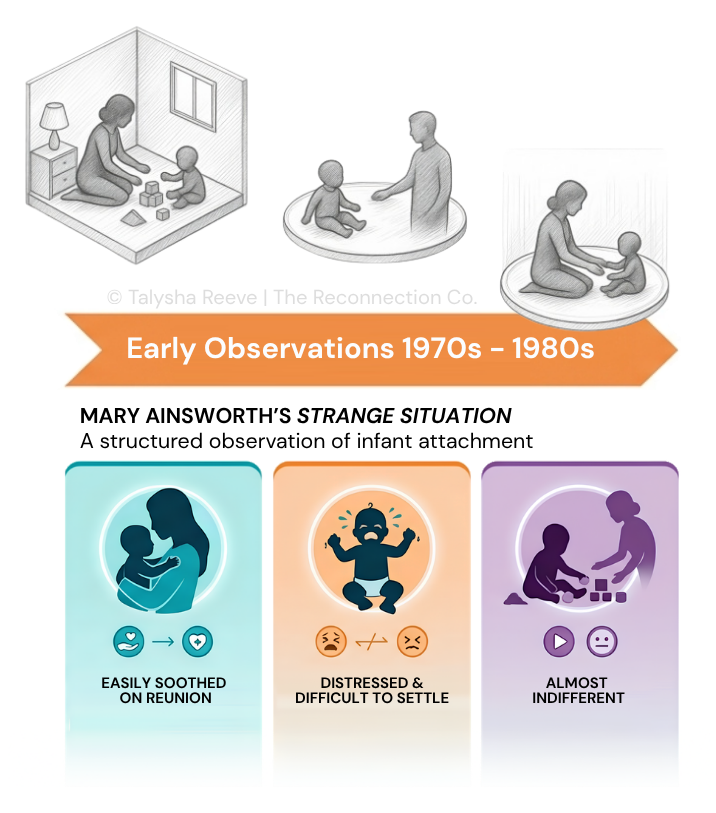
Beginning in the 1970s, Mary Ainsworth designed a study that became known as the Strange Situation; a structured observation in which a child's behaviour was observed.
What they observed, was infants didn't all respond the same way.
Some were easily soothed on reunion.
Others were distressed and difficult to settle.
Others seemed almost indifferent.
These weren't random variations observed, they were patterned, meaningful, and linked to the quality of caregiving the children had received (1,5).
Ainsworth's work gave us the first empirical map of attachment patterns, and it remains the foundation that everything else is built on.
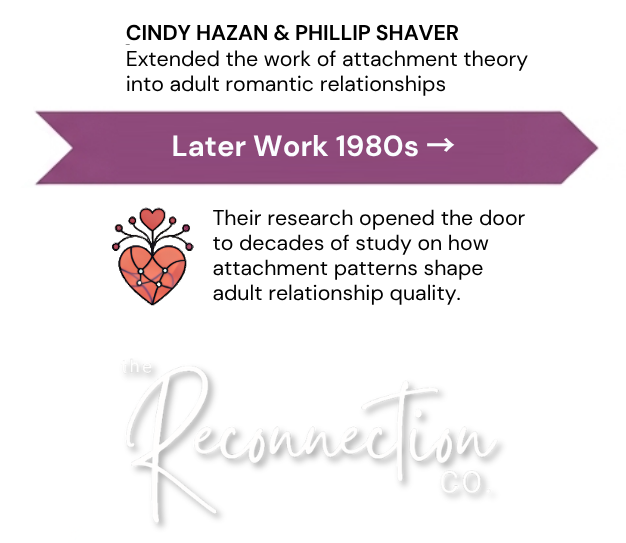
Later, Cindy Hazan and Phillip Shaver extended this work into adult romantic relationships, proposing that the same attachment system operating in infancy is at work in adult love (11). Their research opened the door to decades of study on how attachment patterns shape adult relationship quality. Research that has since been replicated across cultures, age groups, and relationship types (7,13).
The Two Dimensions of Attachment
Research on adult attachment has consistently identified two core dimensions that capture most of the variation in how people relate and these dimensions result in four attachment styles (8,4).
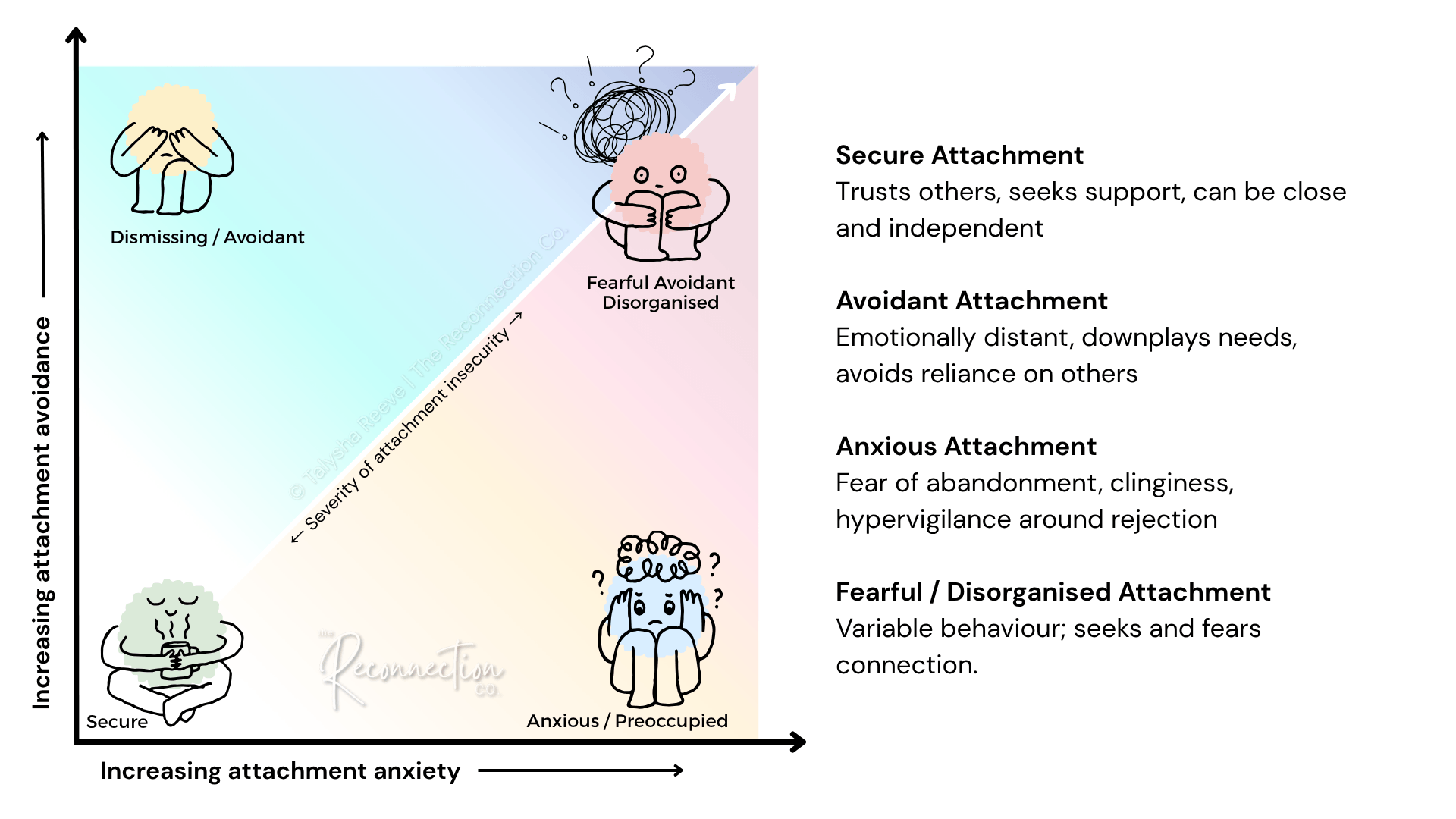
1. Attachment Anxiety
Attachment anxiety refers to how much a person fears rejection, abandonment, or not being enough for their partner.
Higher anxiety in attachment tends to look like needing frequent reassurance, reading ambiguous situations as threatening, and finding it genuinely difficult to self-soothe when conflict or distance arises.
2. Attachment Avoidance
Attachment avoidance refers to how uncomfortable a person may feel with closeness and emotional dependence.
Higher avoidance tends to look like withdrawing when things get emotionally intense, intimate, prioritising self-reliance, and feeling unsettled by a partner's need for connection.
Lower scores on both dimensions describe what's referred to as secure attachment; feeling generally comfortable with closeness, able to lean on others without losing yourself, and not preoccupied with whether your partner is going to leave.
These are dimensions exist on a continuum, vary in severity, are not fixed, and where you sit can shift across different relationships and different periods of your life (7,8).
How and Why Attachment Matters in Relationships
The research on how attachment patterns affect relationship quality is extensive, and it's remarkably consistent across cultures and study types.
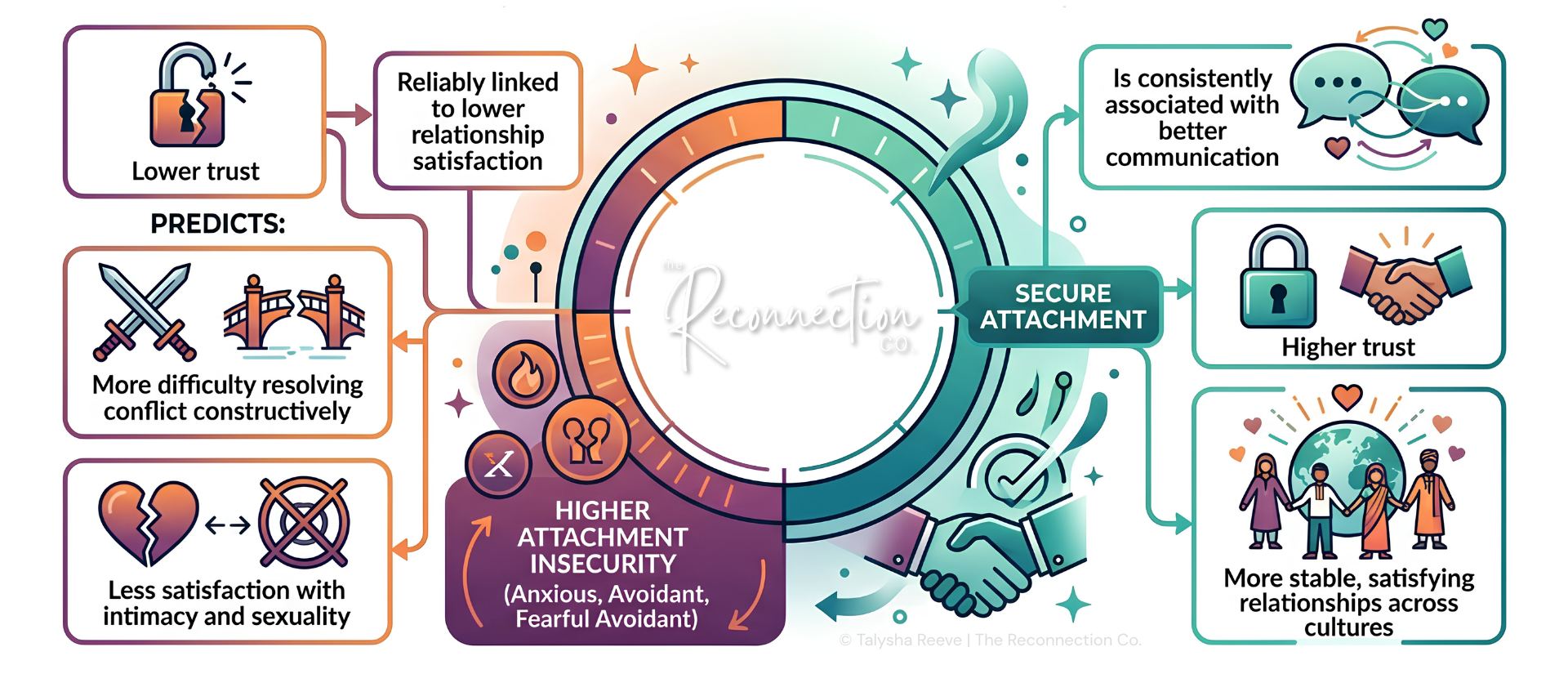
Insecure attachment, whether anxious, avoidant or fearful avoidant, is reliably linked to lower relationship satisfaction (7,14).
The higher the degree of attachment insecurity predicts lower trust, more difficulty resolving conflict constructively, and less satisfaction with intimacy and sexuality (4,6,10). Secure attachment, by contrast, is consistently associated with better communication, higher trust, and more stable, satisfying relationships across cultures (8,13,15).
What's also worth understanding is that your early parental relationships don't determine your outcomes directly. Research suggests they influence your relationships primarily through how secure you feel with your current partner (9).
The past shapes the present but it doesn't lock it in...
Our Internal Relational Blueprints
One of the most important concepts in attachment theory is the Internal Working Model.
Think of it as a blueprint we develop about how to "be" in relationships. This relational blueprint forms our deeply held expectations and beliefs about relationships that we develop early in life, based on how your caregivers responded to you. Our internal working model comprises of how we view ourselves, others, and our relationship with them (3,5).
Our internal working models essentially answer three questions: Am I lovable? Are other people trustworthy? Is it safe to depend on someone? (12,14). They shape expectations and views about yourself, about other people, and about what you can expect when you turn to someone for support.
Internal Working Model
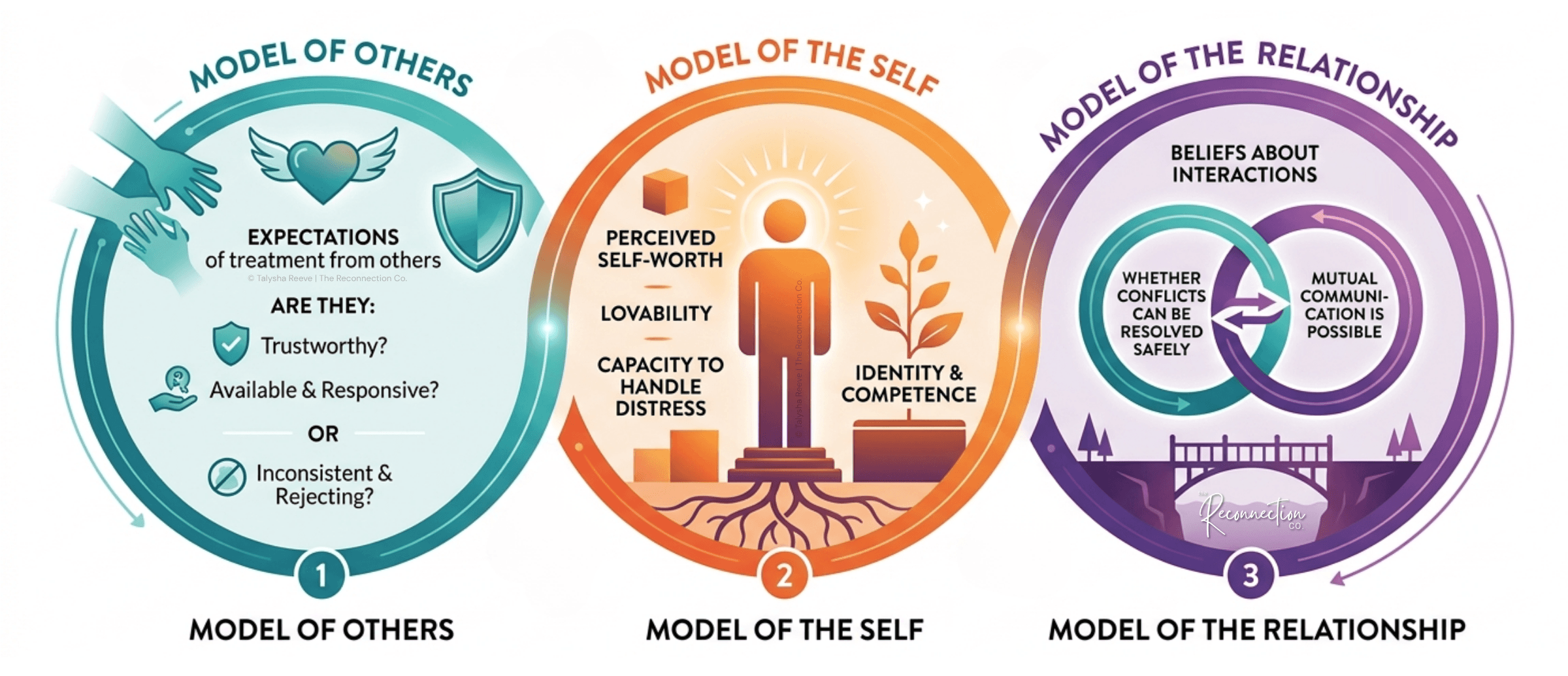
Now, it is important to note that our internal working models can evolve over our lifetime, because they are continually being shaped (for better or worse) by the relationships we have around us, life experiences we have, and the internal work we do (or don't do).
If your early caregiving was consistent and responsive, if your distress was generally met, your needs attended to, and you felt genuinely seen, you likely developed a working model that says relationships are safe, people can be trusted, and conflicts can be resolved safely. In contrast, if your caregiving was inconsistent, dismissive, or frightening, your working model will reflect that too.
The critical thing to understand is that these blueprints don't stay in childhood. They travel with you into every significant relationship you have as an adult, quietly organising your expectations and responses, often below the level of conscious awareness (8,16).
Attachment styles are not fixed. Internal working models (aka relational blueprints) are dynamic, and therapeutic interventions, new relational experiences, and personal growth can update them over time (2,14).
If you have found this article helpful, please share it with others you know who may find it helpful.
If you would like to be one of the first to know when new content & resources from The Reconnection Co. are released, sign-up for updates below.
Next: The Fundamentals of the Four Attachment Styles
References
(1) Ainsworth, M. D. S., Blehar, M. C., Waters, E., & Wall, S. (1978). *Patterns of attachment: A psychological study of the strange situation.* Lawrence Erlbaum.
(2) Bosmans, G., Van Vlierberghe, L., Bakermans-Kranenburg, M. J., Kobak, R., Hermans, D., & van IJzendoorn, M. H. (2022). A learning theory approach to attachment theory: Exploring clinical applications. *Clinical Child and Family Psychology Review, 25*, 591612.
(3) Bowlby, J. (1969). *Attachment and loss, Vol. 1: Attachment.* Basic Books.
(4) Brennan, K., & Shaver, P. (1995). Dimensions of adult attachment, affect regulation, and romantic relationship functioning. *Personality and Social Psychology Bulletin, 21*, 267283.
(5) Bretherton, I. (1985). Attachment theory: Retrospect and prospect. *Monographs of the Society for Research in Child Development, 50*, 335.
(6) Butzer, B., & Campbell, L. (2008). Adult attachment, sexual satisfaction, and relationship satisfaction: A study of married couples. *Personal Relationships, 15*, 141154.
(7) Candel, O., & Turliuc, M. (2019). Insecure attachment and relationship satisfaction: A meta-analysis of actor and partner associations. *Personality and Individual Differences.*
(8) Collins, N., & Read, S. (1990). Adult attachment, working models, and relationship quality in dating couples. *Journal of Personality and Social Psychology, 58*, 644663.
(9) Dugan, K., & Fraley, R. (2022). The roles of parental and partner attachment working models in romantic relationships. *Journal of Social and Personal Relationships, 39*, 21542180.
(10) Fitzpatrick, J., & Lafontaine, M. (2017). Attachment, trust, and satisfaction in relationships. *Personal Relationships, 24*, 640662.
(11) Hazan, C., & Shaver, P. (1987). Romantic love conceptualised as an attachment process. *Journal of Personality and Social Psychology, 52*, 511524.
(12) Hazan, C., & Shaver, P. (1994). Attachment as an organisational framework for research on close relationships. *Psychological Inquiry, 5*, 122.
(13) Martins, L., et al. (2023). A systematic review of the relationship between marital satisfaction and adult attachment styles. *Trends in Psychology.*
(14) O'Shaughnessy, R., Berry, K., Dallos, R., & Bateson, K. (2023). *Attachment theory: The basics.* Routledge.
(15) Pistole, C. (1989). Attachment in adult romantic relationships: Style of conflict resolution and relationship satisfaction. Journal of Social and Personal Relationships.
(16) Simpson, J., & Rholes, W. (1998). *Attachment theory and close relationships.* Guilford Press.
(17) Waters, E., & Cummings, M. (2000). A secure base from which to explore close relationships. Child Development.
Sign-Up for updates from The Reconnection Co.
Be the first to know when new content & resources from The Reconnection Co. are released.
Your information will never be shared with any third parties.