
Wanting to Text Your Ex? Do This First: Pause - Check - Choose
Sep 13, 2026If you've ever sat there with your thumb hovering over "send," you already know the feeling. It's loud. It's urgent. It feels like it needs to happen right now.
That urge is real. It's not a character flaw, nor is it a sign you're "not healing properly".
When a relationship has ended, and it was one where you felt unseen, unheard, and not considered in any of it. Pain is looking for a witness.
"They need to see how their behaviour hurt me."
"What they did is not ok."
That's not you being needy, not you being broken, it's you being human.
Not only is your pain looking for a witness, your attachment system is looking for relief. Even if it's from the person who caused the pain. Your attachment system genuinely activates and pushes you toward contact, even if it's toward the person who hurt you; that's physiology, not weakness.
What urge feels like right now and what it may cost you later are two completely different things to weigh - and your brain is wired to weigh them unevenly.
This is called present bias; it's the reason the relief of sending it feels very loud and immediate, while the cost (restarting the cycle, resetting your own progress, reopening grief you were creating some space to begin move through) feels distant and abstract, even when it's the bigger cost by far.
Before you pick up the phone or put the letter in the post, run through this process:
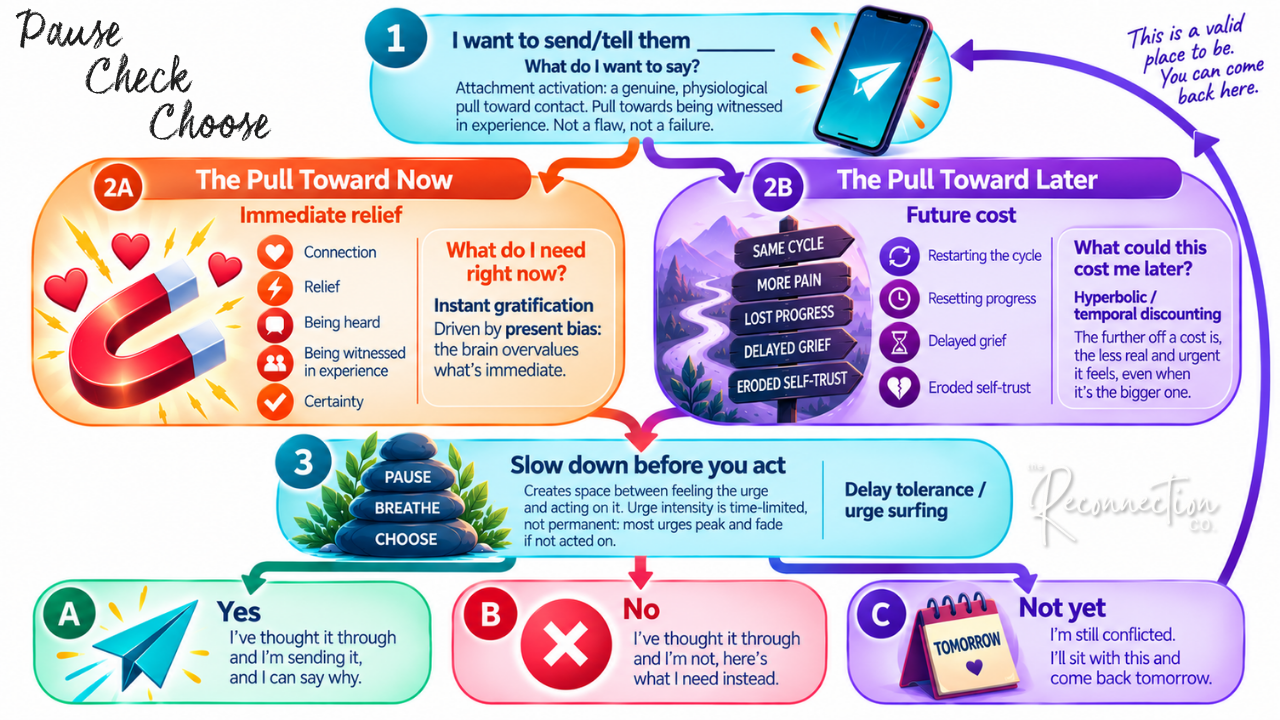
This is where the pause comes in.
Slowing down isn't the same as suppressing the urge or telling yourself you shouldn't feel it.
It's creating a small gap between feeling the pull and acting on it; long enough to actually think, rather than just react.
What's important to know: the intensity of an urge is time-limited.
It can pass within minutes (this is where regulation and urge surfing skills can be really useful). If you don't act on the immediate urge and ride the wave, it tends to peak and then settle, on its own, without you needing to do anything except wait it out.
Even moving yourself through this thought process creates some space between the urge you're feeling and the decision it's trying to move you towards, which is a regulation exercise in itself.
So, when the urge arises, ask yourself:
So next time you're standing at that decision point, try asking yourself:
What am I wanting to do?
What is my system seeking from this action?
What could this cost me in the future?
Sometimes the answer that comes out the other side is a clear yes. Sometimes it's a clear no.
And sometimes it's "not yet, I'll sit with this and check back in later."
"Not yet" is allowed to repeat for as long as it needs to.
It may turn into a yes.
It may turn into a no.
Or the urge may fade away entirely - this is healing.
The pause isn't about never sending it. It's about making sure you're connecting to yourself and what your healing self needs.
Sign-Up for updates from The Reconnection Co.
Be the first to know when new content & resources from The Reconnection Co. are released.
Your information will never be shared with any third parties.