
Fundamentals of the 4 Attachment Styles
Jul 25, 2026Talysha Reeve
Today, we're building on the previous article Attachment Theory 101 - What it is and What it Can Tell You, and now we're taking a closer look at how attachment theory is applied to the human experience via:
The 4 Attachment Styles, what they are and how they appear in relationships.
The purpose of these blogs is to help people understand themselves, their body, and their relationships. I will always do my best to explain as much of the complexities in simple, easy-to-understand ways.
If you ever have any questions about this content or would like to find out about working with me, please get in touch
A Quick Recap: What Is Attachment Theory?
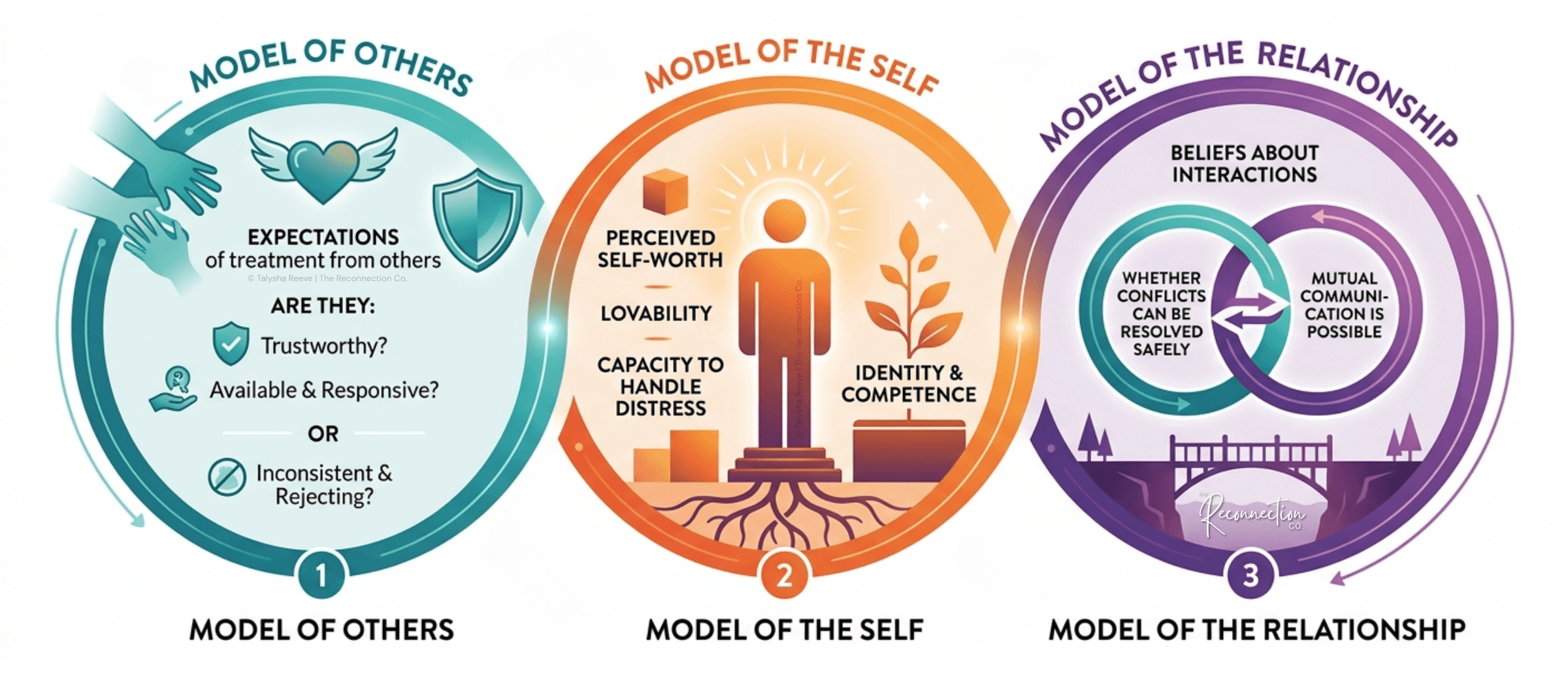
Attachment theory describes how our earliest relationships with caregivers shape the way we relate to others - not just in childhood, but across our entire lives. The quality of that early care shape what's referred to as our internal working models: a kind of psychological blueprint for how safe, lovable, and worthy of support we believe ourselves to be. (5,12,17)
A useful way to hold these two concepts:
Attachment styles describe our behaviours in relationships.
Internal working models describe the beliefs that influence our behaviours when in connection with others.
When caregivers are consistently responsive and sensitive, children tend to develop secure attachment.
However, when care is inconsistent, rejecting, or frightening, children develop emotional coping strategies to adapt to those environments, and those adaptations become what we refer to as the insecure attachment styles. (5,14,20)
These attachment patterns become relatively stable over time, influencing our emotions, mental health, and relationships well into adulthood. (4,14,15,21). Stable means that your nervous system develops a relatively consistent way of responding to emotional stressors.
That said, they can vary in how and when they show up across different connections you have. And, very importantly, they they are not fixed - a person can move from an insecure style toward what's call earned secure attachment, and that process is very much possible with insight, good relationships, and support.
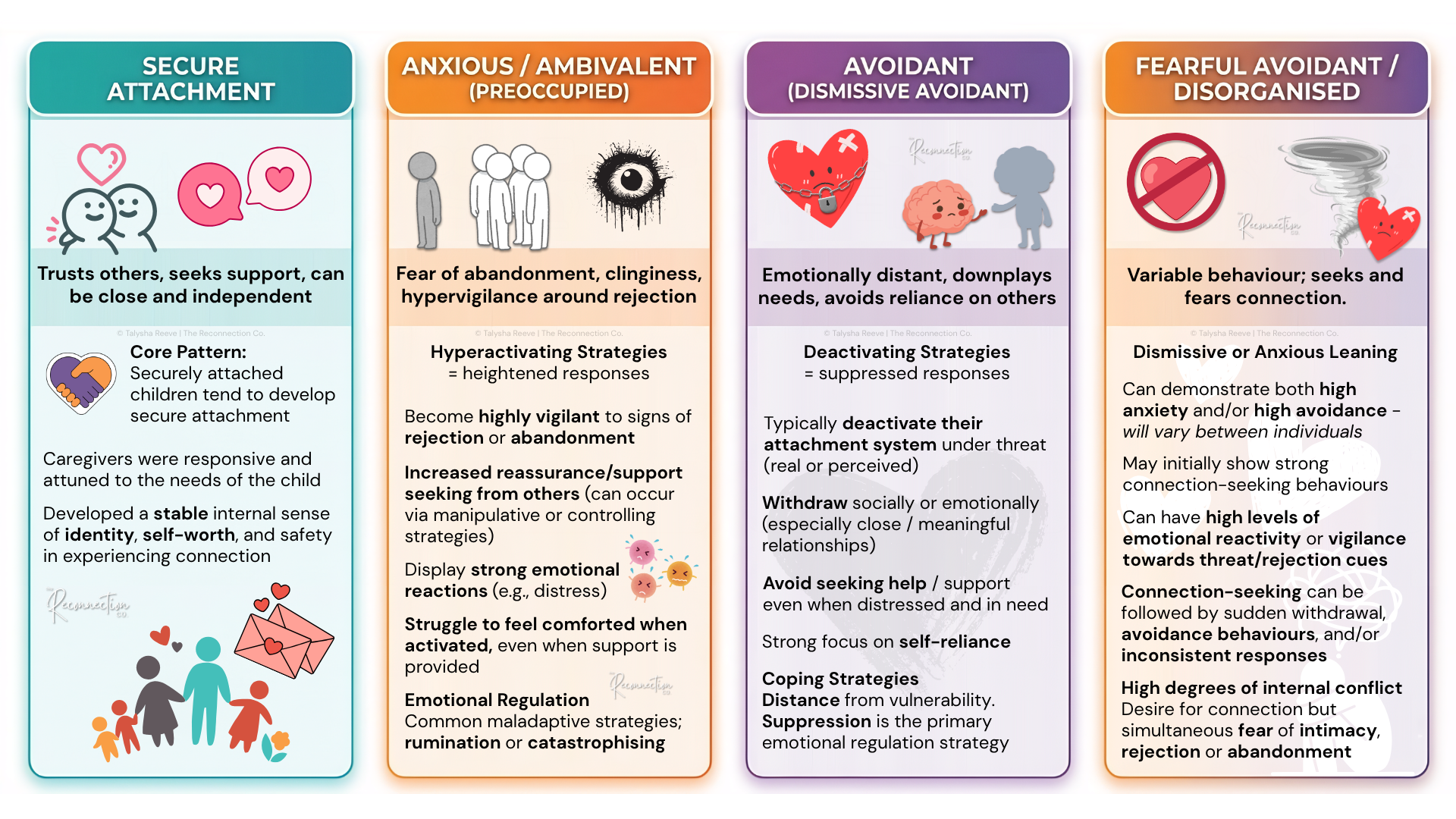
There are four main attachment styles. Here's how they differ.
The Four Styles at a Glance
Attachment styles are often mapped across two dimensions: anxiety (how much a person fears abandonment or rejection) and avoidance (how much a person is uncomfortable with closeness and dependency).
Where someone sits on each of these dimensions shapes which style best describes their attachment behaviours.
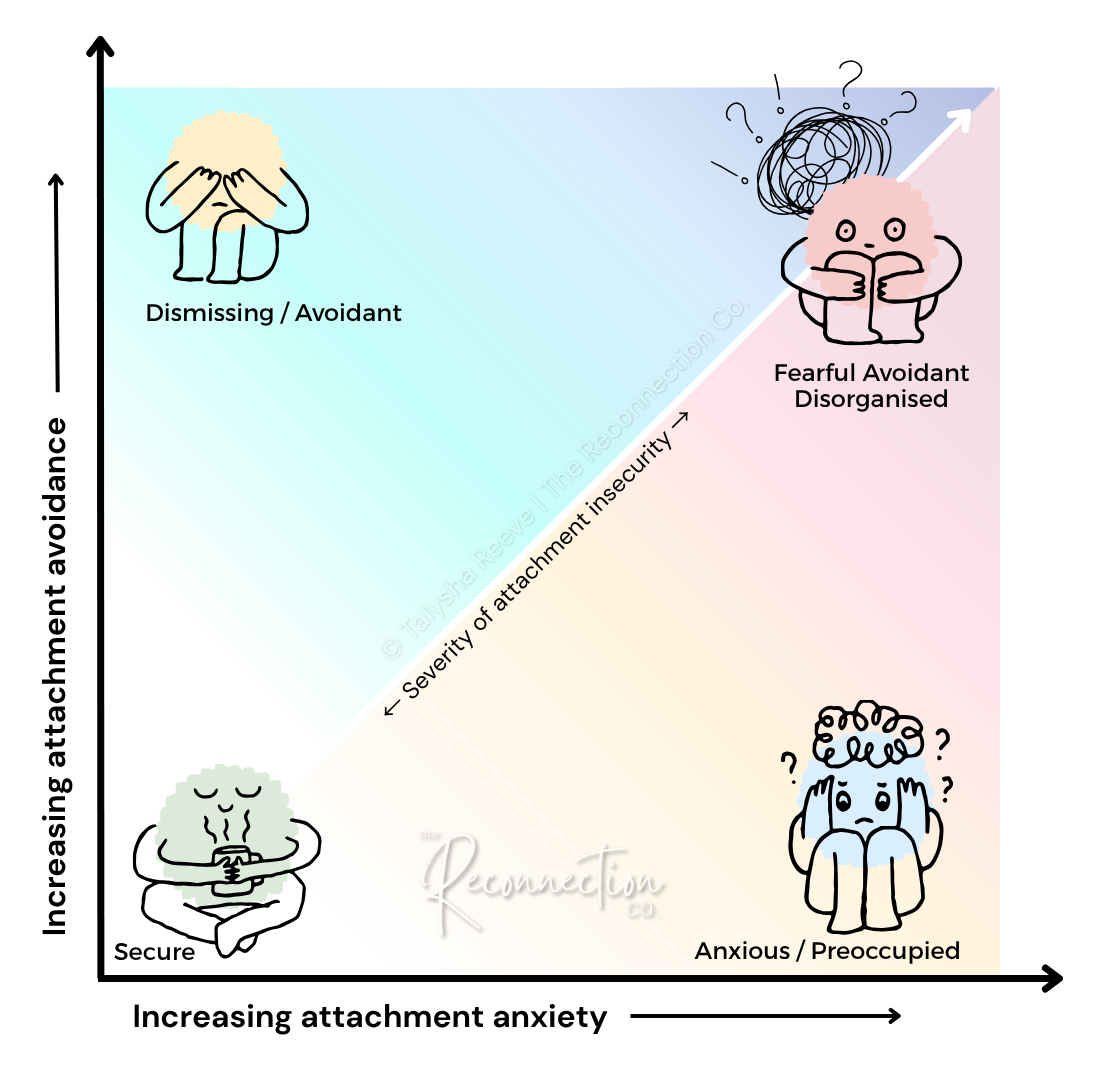
Important to note: Attachment Styles are not a diagnosis and they are not the only factor that influences a person's behaviour.
1. Secure Attachment
Low Anxiety, Low Avoidance
People with secure attachment tend to feel fundamentally worthy of love and capable of depending on others without losing themselves in the process. (11,17)
They can be close without being consumed, and independent without being emotionally unavailable.
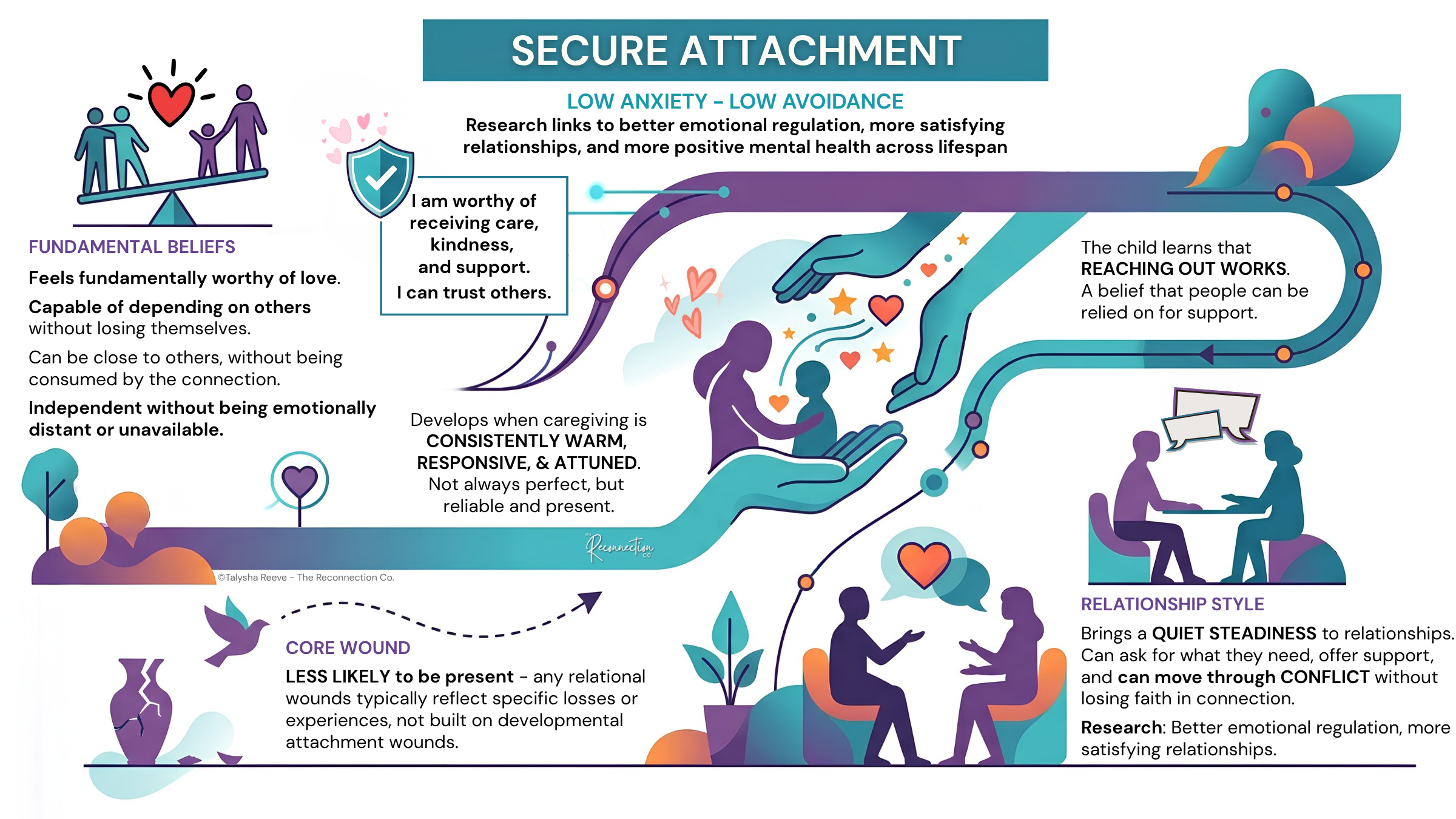
Secure attachment typically develops when caregiving is consistently warm, responsive, and attuned - not perfect, but reliably present. The child learns that reaching out to someone for care, reassurance, or support works, and over time that shapes their deep internal belief: I am worth caring for, and others can be trusted. (5,14)
In relationships, securely attached people typically remain relatively steady when relationships ebb and flow through periods of connectedness and separateness.
Within connections they; can ask for what they need, offer support without losing themselves, and move through normal relational conflicts without losing faith in the connection
Research consistently links secure attachment to better emotional regulation, more satisfying relationships, and better mental health across the lifespan. (11,14,18)
Any core wounds, when one exists, is less likely to be built on a deep attachment wound, but are more likely to reflect specific losses or experiences that have occurred life - rather than a foundational template of relational unsafety.
2. Anxious Attachment (aka Anxious Preoccupied)
High Anxiety, Low Avoidance
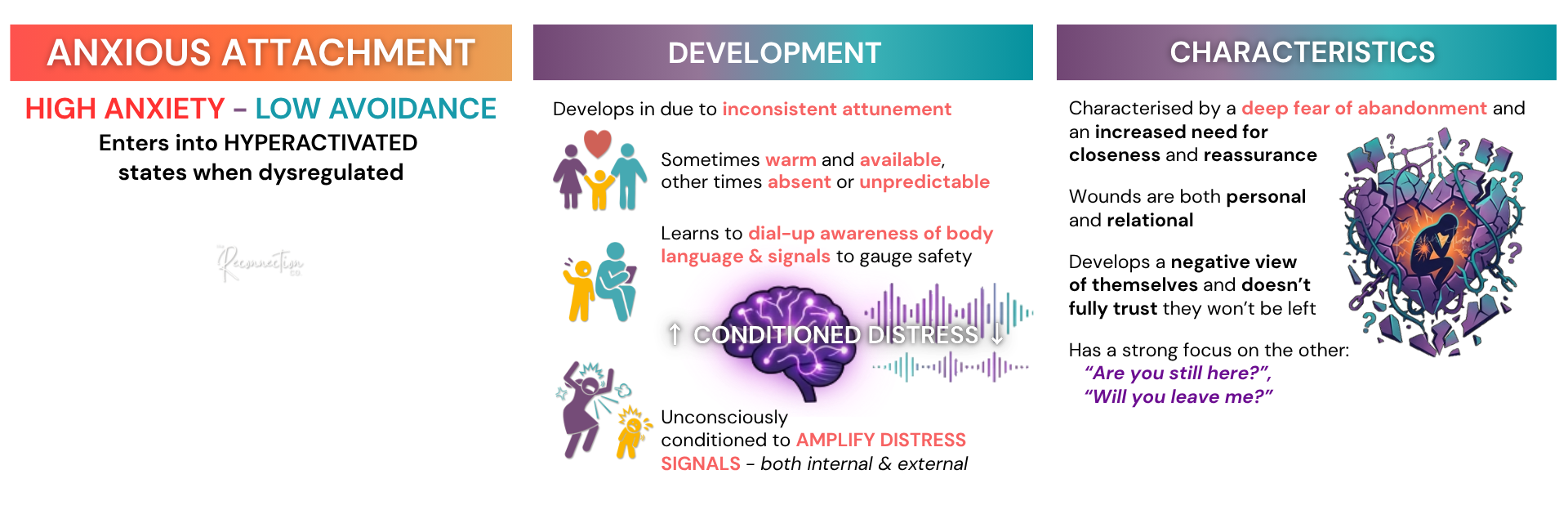
Anxious attachment is characterised by a deep fear of abandonment and an increased need for closeness and reassurance, often paired with an ongoing uncertainty about whether that closeness will actually be there. (5,12,17)
This insecure attachment style typically develops in response to inconsistent caregiving - sometimes warm and available, other times absent or unpredictable. The child learns to amplify their distress signals to bring or keep the caregiver close, and they also learn to become hypervigilant to any signs that connection might be pulled away. (5,12)
In relationships, this can look like: investing quickly and deeply; scanning for signs that something is wrong (hypervigilance); seeking frequent reassurance; difficulty self-soothing when a partner is unavailable; and at times, using emotional intensity or conflict to pull a partner back in when distance feels threatening. (13,19)
At the core of anxious attachment is a wound that is both personal and relational: I am not enough, and because of that, I will be left.
Research links this style to rejection sensitivity, depressive symptoms, and emotional dysregulation. (9,17)
3. Avoidant Attachment (aka Dismissive Avoidant)
Low Anxiety, High Avoidance
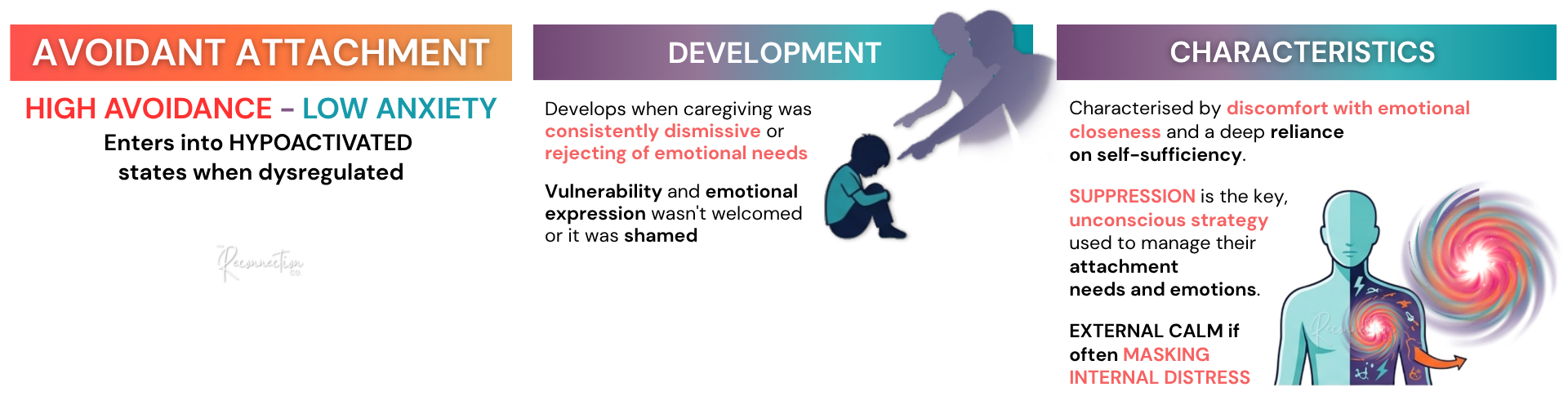
Avoidant attachment is characterised by discomfort with emotional closeness and a deep reliance on self-sufficiency. People with this style have learned to manage their attachment needs and emotions by suppressing them. This emotional suppression self-protection "strategy" rarely develops or persist in adulthood as a deliberate choice, but as a deeply ingrained way of operating at the pre-conscious level of the nervous system. (5,14,17)
Avoidant attachment typically develops when caregiving was consistently dismissive or rejecting of emotional needs; an environment where vulnerability wasn't welcomed or it was shamed, and when reaching out for care or support was rejected. The child learned that the safest strategy was to not have needs. (5,10)
In relationships, this can look like: valuing independence to the point where a partner's need for closeness feels threatening; pulling back during emotional conversations; offering and seeking less comfort under stress; and withdrawing from conflict rather than engaging with it. (6,19)
The core wound here is quieter than anxious attachment, but no less significant: others are unreliable or unsafe, so it's better not to need them (1,10).
Importantly, avoidant individuals often appear calm under pressure, but research shows their bodies are carrying far more stress than their outward composure suggests. (7,8)
4. Fearful-Avoidant Attachment (aka Disorganised)
High Anxiety, High Avoidance
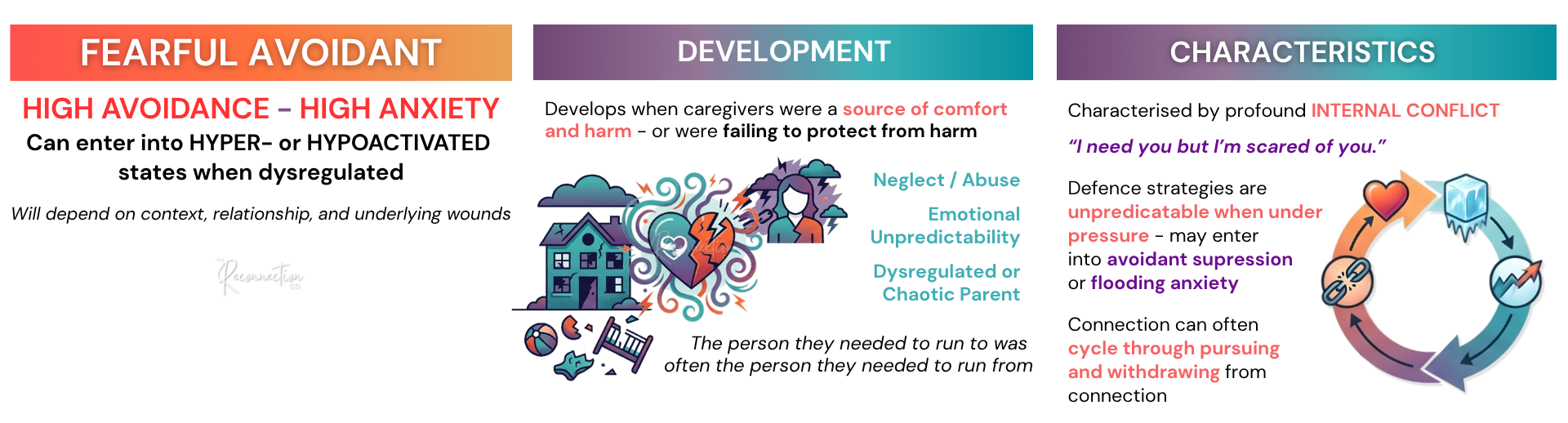
Fearful-avoidant attachment is the most complex and contradictory of the four styles, as the insecure attachment behaviours often sit high on both dimensions - meaning the person desperately wants closeness and is simultaneously terrified of it (3,17). This creates a painful internal conflict: I need you, but I'm also scared of connecting to you. Come closer, but don't come too close.
The fearful avoidant attachment style typically develops when the primary caregiver was also a source of fear - through abuse, neglect, severe unpredictability, or a parent whose own unresolved trauma made them frightening to be around (10,17).
The child's attachment system gets stuck in an experience of inner conflict, because the person they need to run to is often the person they also feel a need to run from.
In relationships, this can look like: intense early connection that suddenly cools; wanting closeness but pushing people away once they get too close; oscillating between clinging and withdrawing; and neither strategy providing lasting relief, because both closeness and distance feel threatening. (2,3)
The core wound is the most complex of all: the people who were supposed to protect me were the source of the danger.
This attachment style carries the strongest links to trauma history and is associated with the highest levels of psychological distress across all four styles. (10,16,17)
A Few Important Things to Keep in Mind
These are patterns, not diagnoses.
Attachment styles sit on a continuum. Most of us carry elements of more than one style, and our patterns can shift - particularly in response to significant relationships, therapy, or major life experiences. (12)
Insecure attachment is not a life sentence.
These patterns were shaped by experience, and experience can continue to reshape them. Understanding your attachment style is not the end of the story - it's often the start of a new one.
Knowing this changes things.
Understanding your own attachment patterns is one of the most consistent predictors of being able to change how they play out. Self-awareness doesn't automatically fix anything, but it makes it genuinely harder to stay on autopilot.
If you have found this article helpful, please share it with others you know who may find it helpful.
If you would like to be one of the first to know when new content & resources from The Reconnection Co. are released, sign-up for updates below.
References
1. Bao, X., Li, S., Zhang, Y., Tang, Q., & Chen, X. (2022). Different effects of anxiety and avoidance dimensions of attachment on interpersonal trust: A multilevel meta-analysis. Journal of Social and Personal Relationships, 39, 2069–2093. https://doi.org/10.1177/02654075221074387
2. Bartholomew, K. (1990). Avoidance of intimacy: An attachment perspective. Journal of Social and Personal Relationships, 7, 147–178. https://doi.org/10.1177/0265407590072001
3. Beeney, J. E., Wright, A., Stepp, S., Hallquist, M., Lazarus, S. A., Beeney, J., Scott, L. N., & Pilkonis, P. (2017). Disorganized attachment and personality functioning in adults: A latent class analysis. Personality Disorders: Theory, Research, and Treatment, 8, 206–216. https://doi.org/10.1037/per0000184
4. Bell, K. L. (2001). Handbook of attachment: Theory, research, and clinical applications. Journal of Marriage and Family, 63, 588. https://doi.org/10.5860/choice.37-1841
5. Bosmans, G., Bakermans-Kranenburg, M., Vervliet, B., Verhees, M., & Van IJzendoorn, M. H. (2020). A learning theory of attachment: Unraveling the black box of attachment development. Neuroscience and Biobehavioral Reviews, 113, 287–298. https://doi.org/10.1016/j.neubiorev.2020.03.014
6. Bretaña, I., Alonso-Arbiol, I., Recio, P., & Molero, F. (2022). Avoidant attachment, withdrawal-aggression conflict pattern, and relationship satisfaction: A mediational dyadic model. Frontiers in Psychology, 12. https://doi.org/10.3389/fpsyg.2021.794942
7. Diamond, L., Hicks, A. M., & Otter-Henderson, K. D. (2006). Physiological evidence for repressive coping among avoidantly attached adults. Journal of Social and Personal Relationships, 23, 205–229. https://doi.org/10.1177/0265407506062470
8. Eilert, D. W., & Buchheim, A. (2023). Attachment-related differences in emotion regulation in adults: A systematic review on attachment representations. Brain Sciences, 13. https://doi.org/10.3390/brainsci13060884
9. Finzi-Dottan, R., & Abadi, H. (2024). From emotional abuse to a fear of intimacy: A preliminary study of the mediating role of attachment styles and rejection sensitivity. International Journal of Environmental Research and Public Health, 21. https://doi.org/10.3390/ijerph21121679
10. Grady, M. D., Yoder, J., & Brown, A. (2018). Childhood maltreatment experiences, attachment, sexual offending: Testing a theory. Journal of Interpersonal Violence, 36, NP6183–NP6217. https://doi.org/10.1177/0886260518814262
11. Groh, A., Fearon, R., Van IJzendoorn, M. H., Bakermans-Kranenburg, M., & Roisman, G. I. (2017). Attachment in the early life course: Meta-analytic evidence for its role in socioemotional development. Child Development Perspectives, 11, 70–76. https://doi.org/10.1111/cdep.12213
12. Khan, F., Chong, J. Y., Theisen, J. C., Fraley, R. C., Young, J. F., & Hankin, B. (2020). Development and change in attachment: A multiwave assessment of attachment and its correlates across childhood and adolescence. Journal of Personality and Social Psychology. https://doi.org/10.1037/pspi0000211
13. Knox, L., Karantzas, G., & Ferguson, E. (2023). The role of attachment, insecurity, and stress in partner maltreatment: A meta-analysis. Trauma, Violence & Abuse, 25, 721–737. https://doi.org/10.1177/15248380231161012
14. Li, Y. (2023). How does attachment style influence early childhood development. Journal of Education, Humanities and Social Sciences. https://doi.org/10.54097/ehss.v8i.4675
15. Ludwikowska-Świeboda, K. (2022). Adult attachment styles and psychosocial health. Journal of Education, Health and Sport. https://doi.org/10.12775/jehs.2022.12.08.004
16. Rholes, W., Paetzold, R. L., & Kohn, J. L. (2016). Disorganized attachment mediates the link from early trauma to externalizing behavior in adult relationships. Personality and Individual Differences, 90, 61–65. https://doi.org/10.1016/j.paid.2015.10.043
17. Sekowski, M. M., & Gambin, M. (2025). Attachment anxiety, avoidance, and disorganization: Latent profiles of attachment and their associations with hypomentalization, depressive symptoms, and suicidality. Journal of Clinical Psychology. https://doi.org/10.1002/jclp.70019
18. Simpson, J. A., Collins, W., Tran, S., & Haydon, K. (2007). Attachment and the experience and expression of emotions in romantic relationships: A developmental perspective. Journal of Personality and Social Psychology, 92(2), 355–367. https://doi.org/10.1037/0022-3514.92.2.355
19. Simpson, J. A., & Rholes, W. (2017). Adult attachment, stress, and romantic relationships. Current Opinion in Psychology, 13, 19–24. https://doi.org/10.1016/j.copsyc.2016.04.006
20. Tsouvelas, G., Laious, R., Chondrokouki, M., Antoniou, X., & Nikolaidis, G. (2025). Aspects of attachment in relation to early maladaptive schemas in children residing in child care facilities. Clinical Psychology & Psychotherapy, 32(3), e70095. https://doi.org/10.1002/cpp.70095
21. Urban, J. R. (2020). Attachment theory and its relationship with anxiety. The Kabod: The Journal of the Liberty University Honors College. https://doi.org/10.70623/lxut7297
Sign-Up for updates from The Reconnection Co.
Be the first to know when new content & resources from The Reconnection Co. are released.
Your information will never be shared with any third parties.